


The Girl Who Danced Before She Could Speak: Aritree's Journey

Updated: Sep 3
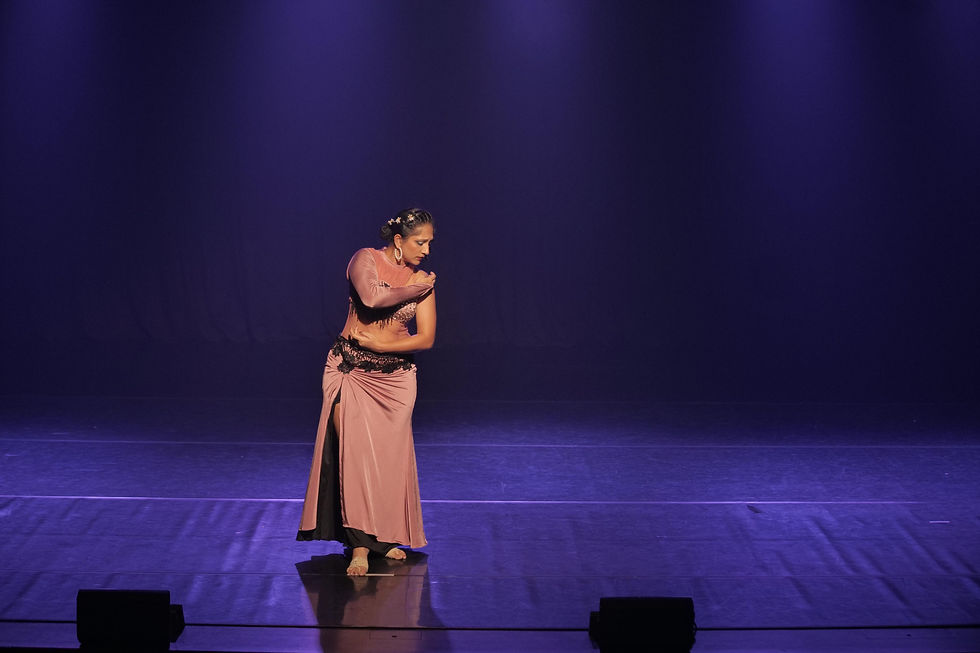
Long before dance became a discipline, a profession, or even a conscious choice, it was simply something Aritree did. Her mother still tells the story: before Aritree could speak in full sentences, she had already begun dancing. Her older sister would go for Bharatanatyam classes, and Aritree would sit nearby, watching intently. When she came home, she would reproduce the steps she had seen.
“This was when I had started walking ...I would sit and watch her and come back and copy the exact same steps.”

It was perhaps the earliest indication of something that would remain remarkably consistent through the years: Aritree watches, absorbs, remembers, and then moves.
Her first formal training came in Kathak, beginning somewhere around Class One or Two. Kathak stayed with her for years, alongside the informal, eclectic dance education that was common in her childhood in Kolkata—colony programmes, school performances, creative dance classes, and whatever other forms happened to cross her path. She remembers knowing the steps of practically everyone around her, from the youngest children to the older dancers.
“They would still come and ask me, tell me what is this step?”
Her family, particularly her mother, never questioned the importance of dance in her life. Whether it was a competition, an examination, or simply a teacher asking her to perform somewhere, her mother made sure she got there.
The journey, however, was anything but linear. There were breaks. Teachers stopped teaching. A brief attempt at another form did not work out. She eventually found another Kathak teacher and continued training, but life repeatedly placed distance between her and the studio.
Then, in 2014, she moved to Bangalore for college. And dance, for a while, receded into the background. She danced at college festivals, but formal training disappeared for years. Eventually, around 2017–18, she enrolled in belly dance classes and returned to the studio. She trained for about a year before a surgery forced another break.
“I was very sad. Every time I start something, there’s like a block.”
It is a pattern that would recur throughout her journey: she would begin, something would interrupt, and eventually she would find her way back. Injury, work, circumstance, grief - each would create its own pause. None, however, managed to make dance disappear.
Finding her way back to dance
The first step towards belly dance was almost incidental. A friend suggested they try a demo class.“Do you want to go for just a belly dance class?”
“Yeah, sure. Why not?”
That small decision became another turning point. When she eventually came across Debapriya and Nrityakosh, something clicked. Here was a space where Kathak, belly dance and fusion could coexist - precisely the kind of movement environment that appealed to her. “I realized, wow, this lady does Kathak and fusion and belly dance. This is my ideal place.”
She joined Nrityakosh as an intermediate dancer in 2020. Her progression was rapid: intermediate, advanced, and eventually company dancer. But even that progression was interrupted repeatedly.
She joined Nrityakosh just before the pandemic, then hurt her ankle. When online classes began, she told Debapriya about the injury but also made one thing clear: she could not stop dancing. “I have an injury, but I can’t not dance.”
Debapriya told her to take it slowly. And so she did. As her journey continued to be shaped by stops and starts - moving back to Kolkata for a period, working through weekends, training whenever possible - she eventually began considering what it would mean to take dance seriously.
Choosing dance
Aritree was working as a counselling psychologist, first in startups and later in corporate roles. The practical realities of work often made dance difficult to sustain. At one point, she worked shifts that stretched from 2 p.m. to 11 p.m., sometimes even through the night. She remembers going to class after sleeping only a few hours, or attending a class before heading to work.
Things became somewhat easier when she joined Cult, but the weekends were still largely consumed by work. For a long time, Thursday morning was the only class she could consistently attend.“I could literally only do Thursday mornings.”
She believes that period delayed her progression within Nrityakosh. She could have joined the advance classes earlier, but the timings simply did not work. Eventually, she began working independently. That gave her the flexibility she had been missing - the ability to take a day off before a show, fit rehearsals around work, and, most importantly, make decisions about her own time.
She returned to Bangalore, joined the advance classes, and gradually moved deeper into Nrityakosh.
Then came the Company. Debapriya eventually asked her to join. She joined the Company in the second half of 2024.
'No more running'
For someone who describes herself as deeply introverted and shy, becoming a company dancer brought an unexpected set of challenges.
She had never imagined herself standing in front of a class and teaching a workshop. She had certainly never imagined herself speaking on stage.

When she first saw Nrityakosh dancers speaking on stage at In Lieu of Flowers, she remembers thinking:
Oh my God. Should I really join the Company? What if I have to speak on stage?
Then, a year later, she was the one doing it. She remembers the first line she delivered during To Burn to Bloom. She sat down, took a breath, and told herself: “This is it. There is no running away. I have to do it.”
She said the line loudly - much louder than she expected herself to.
It became a cherished moment, not because the performance was perfect, but because of what it represented. The same is true of teaching. She has conducted only two of workshops so far, and the nerves have not magically disappeared. But the fact that she has stood in front of a room and done it has changed something fundamental. "That was my first income through dance, and that was really special," she said.
A body that keeps returning
Injury has been one of the more difficult chapters of her dance journey. Her ankle has been injured multiple times. She has also dealt with a back injury and, more recently, a knee injury. Each time, the injury has been accompanied by something more difficult to articulate: the emotional experience of being unable to move in certain ways.
She jokes about her conversations with her physiotherapist. “Every time I come back to him, before he even asks what has happened, I tell him, ‘Don’t ask me to stop dancing.’”
But underneath the humour is a genuine struggle. She did not even manage to take the full break. “I sat in front of the class. I’m like, what do people do when they sit?”
She is still learning how to navigate that relationship with injury- to respect what her body needs and to create a more sustainable, long term relationship with her body. “I definitely want to dance for the next 50 years.”
More than a hobby
Aritree still calls dance her hobby. Mostly because she jokes that she doesn't have any other hobbies.
But the word is not quite enough.
“Dance is my hobby, but I feel like I don’t have any other hobbies in my life. But it’s definitely more than just a hobby.”
Dance, for her, has remained strangely constant even when everything else has shifted. There were years when she did not train. There were jobs that consumed her time. There were injuries, relocations and long gaps. Still, she would return.
Sometimes she returns reluctantly. She might be exhausted, busy, or simply unwilling to wake up at six in the morning and travel across the city. And yet, once she enters the studio, something changes.
“Even if I’m hungover on a Friday night or a Saturday night, I enter the studio and there’s something in me that always changes.”
She doesn't describe dance as an escape from sadness, or as a magical place where everything becomes happy. “It feels like it fills some part of the void, maybe sometimes, in my life.”
That is why the long gaps have always felt strange. When she moved to Bangalore in 2014 and went years without proper training, she remembers feeling that something significant was missing.
Even in college, when she wasn't training regularly, people knew her as the girl who danced. At a small college, one performance was enough for an entire campus to know her name.
She would dance at college festivals. Family friends would remember her performances. During the pandemic, she and her Kathak teacher even started making short videos of Kathak footwork set to different songs.
People would message her mother asking when the next reel was coming out. It seems fitting, then, that one of the simplest ways Aritree describes herself is also one of the most enduring:
“I’m a dancer.”
Dance and the mind
There is another part of Aritree's life that runs alongside dance: psychology. She became interested in psychology relatively early. Her mother encouraged her towards it, and by Class 8 or 9 she was herself attending counselling. In Class 11, she chose humanities, eventually pursuing psychology at university in Kolkata.
She considered sociology as well, but psychology felt like the path with greater possibilities. After graduation from Calcutta University, she wanted to specialise rather than pursue research. She chose counselling, eventually completing her postgraduate training at Montfort, drawn to its emphasis on practical counselling skills. “I wanted to be a therapist.”
She still describes herself as someone who naturally listens. Even before becoming a therapist, friends would come to her when something was wrong.


Comments